
Analytical instrumentation plays a major role in most of our studies, and we rely on the following high-end instrumentation:
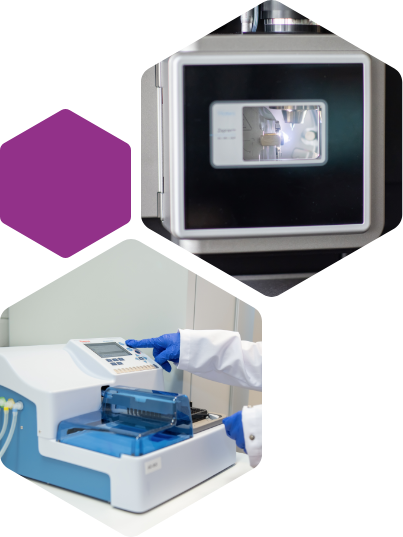
- UPLC* + Waters Vion IMS QTof (with fluorescence detector)
- 3 × UPLC* + Waters TQ Absolute triple-quad MS
- UPLC* + Waters Xevo TQ-XS triple-quad MS
- 2 × UPLC* + Waters Xevo TQ-S triple-quad MS
- UPLC* + Thermo Scientific TSQ Quantis triple-quad MS
- UPLC* + Thermo Scientific TSQ Endura triple-quad MS
- 4 × UPLC* + Thermo Scientific Q Exactive Orbitrap MS/OE120 Orbitrap MS (with PDA detector)
- On-line LC-radioactivity detector (Berthold)
- 2 × Liquid handling robot (Beckman Coulter)
- 2 × qPCR (Life Technologies)
- Microplate reader (BioTek)
- Beta microplate reader (Hidex Sense)
- Liquid scintillation counter (Hidex 300SL)
- Automated fluorescence microscope ImageXpress Nano (Molecular Devices)
*Waters Acquity or Thermo Vanquish Horizon
Contact us for more information.
Frequently Asked Questions
Analytical instrumentation plays a central role in many Admescope studies. Advanced mass spectrometry, chromatography, radiodetection, molecular biology, and imaging technologies support the generation of high-quality data across ADME-Tox, DMPK, bioanalysis, and drug metabolism research.
Admescope operates a range of LC-MS platforms, including Waters Vion IMS QTof, Thermo Scientific Orbitrap systems, and multiple triple quadrupole mass spectrometers. These technologies support quantitative bioanalysis, metabolite identification, metabolite profiling, and other ADME-Tox applications.
Yes. Admescope’s analytical capabilities include on-line LC-radioactivity detection and liquid scintillation counting, supporting studies involving radiolabeled compounds and radiometric analysis.
Yes. Admescope utilizes high-resolution mass spectrometry platforms including Waters Vion IMS QTof and Thermo Scientific Orbitrap systems. These technologies are commonly used to support metabolite identification, structural characterization, and qualitative analyses.
Yes. Admescope operates multiple triple quadrupole LC-MS systems designed to support sensitive and reliable quantitative bioanalysis across a wide range of drug discovery and development studies.
Admescope’s instrumentation includes qPCR systems, automated fluorescence microscopy, microplate readers, and liquid handling robotics. These technologies support a variety of assay workflows across Admescope’s ADME-Tox, DMPK, and bioanalytical services.
Yes. Admescope’s analytical platform supports both qualitative investigations, such as metabolite identification and structural characterization, and quantitative analyses including bioanalysis and pharmacokinetic sample analysis.
Reliable analytical data are essential for understanding compound behavior, metabolism, exposure, and safety. Advanced instrumentation helps generate the high-quality data needed to support informed decision-making throughout drug discovery and development.