
Our services for Safety Metabolism research include
- Metabolite profiling and characterization in pre-clinical species (in vitro and in vivo MetID)
- Human metabolite profiling and characterization (FIM, SAD, MAD)
- Human MIST analysis (MAD + preclinical safety species)
- Metabolite profiling and characterization in radiolabeled human ADME study
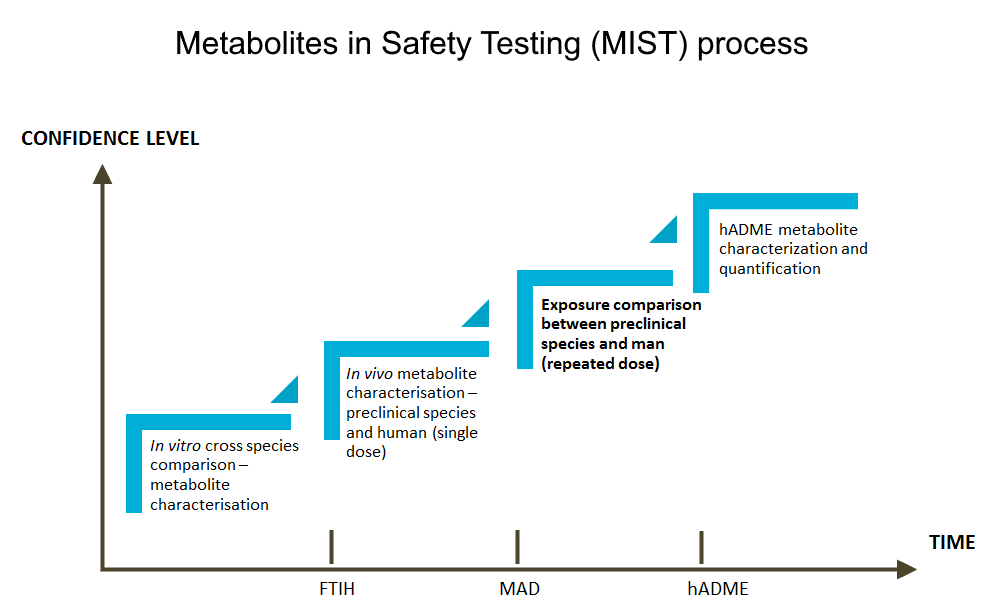
After administration, a drug is usually converted to a variety of metabolites in the liver, GI-tract and/or extrahepatic tissues. Due to species-, strain- and sometimes sex-specific isoforms and metabolic capacities of enzymes, not only the parent drug but also its metabolites that should be tested for its pharmacological and toxicological effects during pre-clinical safety testing of drug candidates. For safety purposes, it is especially crucial to identify metabolites that are disproportionate or unique in humans.
Our services help you to confirm the exposure to human metabolites is adequate in preclinical safety species, or to effectively identify potential MIST issues in time through a battery of different types of studies. While the first investigations related to the topic are performed as in vitro cross-species metabolite profiling and identification, the workflow is continued with various in vivo metabolite characterization studies, using samples from animal and human studies with cold and radiolabeled study compounds.
Exploratory in vivo studies are performed with non-labeled compounds and LC/MS analysis of plasma samples from pre-clinical toxicological studies and first in man studies, to understand the probability of a MIST issue, while steady state exposure comparison between preclinical species and human is the ultimate study to evaluate if human metabolites are toxicologically qualified. Metabolite profiling and identification from human radiolabeled ADME study is the optimal way to define which human metabolites fall under the criteria of FDA and ICH guidelines.
Disproportionate metabolite – when a metabolite is produced at significantly higher extent in humans than in preclinical safety species.
Unique human metabolite – when a metabolite is exclusively produced in humans.
MIST – Metabolites in Safety Testing. The FDA guidance (CDER. Guidance for Industry: Safety Testing of Drug Metabolites) provides recommendations on when and how to identify and characterize drug metabolites whose nonclinical toxicity needs to be evaluated, while further harmonization of the nonclinical safety studies of clinical development among the regions of European Union, Japan, and the United States can be found from the ICH M3 guidance (M3(R2):Guidance on nonclinical safety studies for the conduct of human clinical trials and marketing authorization for pharmaceuticals).
Frequently Asked Questions
Safety metabolism studies help identify, profile, and characterize drug metabolites that may need further toxicological evaluation. They are used to assess whether human metabolites are adequately covered in preclinical safety species and to identify potential metabolites in safety testing (MIST) concerns during drug development.
Admescope offers metabolite profiling and characterization in preclinical species, human metabolite profiling, MIST analysis, radiolabeled human ADME metabolite profiling, and studies designed to identify disproportionate or unique human metabolites.
MIST stands for Metabolites in Safety Testing. MIST analysis evaluates whether drug metabolites observed in humans have been adequately represented in preclinical safety studies, helping determine whether additional metabolite characterization or toxicological assessment may be needed.
Unique or disproportionate human metabolites may not be sufficiently covered by preclinical safety species. Identifying them helps project teams assess whether human metabolite exposure has been adequately qualified and whether further safety evaluation may be required.
Yes. Admescope supports human metabolite profiling and characterization using samples from first-in-man, single ascending dose, multiple ascending dose, and radiolabeled human ADME studies to help evaluate metabolite exposure in humans.
Yes. Safety metabolism workflows can begin with in vitro cross-species metabolite profiling and continue with in vivo metabolite characterization using samples from preclinical toxicology, first-in-man, and human ADME studies.
MIST risks should be investigated as part of metabolite profiling and safety assessment during preclinical and clinical development. Early cross-species studies can help identify potential issues, while steady-state exposure comparisons between humans and preclinical safety species provide stronger evidence for metabolite safety qualification.